Search This Blog

Sunday, April 22, 2012

Up with People


Vivien Leigh as Blanche DuBois

This week we gave life to Blanche DuBois’ memorable line from A Street Car Named Desire, “…I have always depended on the kindness of strangers.”  It just so happened this time that we were the strangers.


Our doors to two members of the cast of Up with People were flung open though the ever-fluid life encounters that frame our lives in Sweden. Upon our arrival in Sweden, we adopted with keen intent a vow to attend, visit and participate in as many events as we could manage to extend our roots here. We have remained true to that pledge.

Lorna from Ireland and Neoko from Japan
It was through Helen’s networking for her Dining for Women chapter that lead to a chance encounter with the advance team staff of Up with People charged with, among other things, finding host families for youthful cast members. For the past week we have been the host family for Naoko from Japan and Lorna from Ireland. They occupy our spare bedrooms, share meals and bring us back in touch with the twenty-something generation.

Up with People has been around since the halcyon days of the ‘60’s when it was primarily known for its musical productions and international tours. Today’s Up with People has an updated program with a global perspective focused on community service and educational programs along with its traditional musical program.  

The 120 members of the tour started in United States then travelled to Belgium, Norway and now Sweden.  Next is Finland and then on to Mexico. 

Long curls are part of Lorna's
costume for her Irish dancing 
Due to a business trip Jay could not attend the music performance on Wednesday.  Helen observes, “It was two-hours of high energy entertainment!”  The musical feast was a well-considered fare of current pop and old rock ‘n roll. Kids and host family moms and dads all had opportunities for toe-tapping and lip-synching fun.

We have not, however, had many opportunities to spend time with Naoko and Lorna. The day after her arrival, Naoko got on a plane for a trip to the island of Gotland off the coast of southern Sweden to spend her 26th birthday with friends. Lorna has been ill and in need of rest. 

Buffet line Saturday night
Their schedules are really packed with planned activities by the Up with People staff. As one staff member shared with Helen at the host family dinner Saturday night, “Gone are the days when community service was singing for one hour at an old folks home.” Naoko, for example, spent a day at a local homeless shelter planting flowers and meeting the people there.

We are heartened to see young people globally collected and brought together in common community and purpose. We are becoming a more populated planet.  We are happy to see there is a generation of new leaders who will not let our six degrees of separation from one another suffer in the process.

Saturday, April 14, 2012

A Riotous Score

SCORE!!!!!
A standard comic caricature of a soccer announcer includes an exaggerated pronunciation of, “SCORE!”  Our American roots, however, simply don’t allow us to tap into this worldwide enthusiasm for people running around in short pants kicking a black and white ball.  What’s all the fuss about?

Rioters right behind our apt.
We were equally confused this evening when we heard hoots, yells and jeers from the courtyard and park adjacent to our apartment. Jay quickly grabbed his camera. Two groups of young men, each numbering in the 50+ range, converged in a headlong Braveheart-like rush and began beating one another senselessly.  What’s this all about?

Soccer Fans and Police Face Off 
The police quickly arrived and with professional precision separated the warring factions.  The surge subsided only to re-emerge on the same field of battle 20 minutes later.  The police arrived again but were now better equipped with horse mounted officers, flash grenades, pepper spray and an ambulance, just in case.

After the second and final battle was quelled, Jay went outside and spoke with a knot of officers.  He learned the melee was among rival soccer fans.   Evidently such outbreaks regularly occur with the opening of the soccer season.

We returned to our humdrum activities in the apartment.  Jay downloaded video and still images he took of the event to his computer to assemble a short video.  The quiet was again broken by a knock on our apartment door.

Two police officers stood in the doorway.   As through ripped from a script from Law & Order, one officer flashed his badge and asked if we had witnessed or had any images of the riot.  We invited them in to see the high definition video and images that Jay had loaded on his MacBook.  In their excited response they failed to perform the normally quick translation of the English j sound and replied simply on their native Swedish pronunciation, “Yackpot!”

In the viewing of images, particular attention was paid to isolating an individual whose participation in the riot had resulted in his arrest. “He’s wearing purple pants.”  Dressed in something that made him so easily identifiable, we suspect hooligans, regardless of nationality, are not the sharpest tools in the shed. 

The police requested and received copies of the still and video images.

The experience provided us a unique opportunity to glimpse a few layers deeper into Swedish life.   Clearly there are complexities and textures to any society.   So the next time we take our number at the deli counter and wait our turn to participate in the seemingly never-ending orderly Swedish society, we will know that we are only on the edge of our cultural appreciation of our European home.

Below is a short video of the rioting fans.

Monday, April 9, 2012

Easter Weekend in Göteborg

King Gustaf II Adolf

We took our first inner Sweden trip this weekend to the country’s second largest city, Göteborg (pronunciation link). Gothenburg is the English name for the city.

The King of Swat
Located on the western shores of Sweden, Göteborg has a rich history of seafaring trade. The official founding of the city is anchored in the 1621 declaration by King Gustaf II Adolf that, “The town shall be here.” A statue of a pointing king commemorating this declaration is reminiscent of our own King of Swat, Babe Ruth, declaring the placement of his next home run in the 1932’s World Series.  We, however, had far less certainty of what to expect when we arrived on the train from Stockholm.   
The Viking
We wandered city streets and the pedestrian walkways and were delighted to discover that not everything was closed. Dinner that evening was on a 1906-built four-masted sailing ship that once ferried Australian wheat to market and was now converted to a hotel / restaurant. 

 mounted whale w/seating inside 
The next morning we headed to Slottsskogen, an expansive park, to visit the Natural History Museum.  Our first pleasant surprise was to learn that our 40 crown each ($6) entrance fee included admission to four other museums, as well!  The Natural History Museum is a gem, offering exhibits on fish, mammals, birds, human evolution and a “bucket list” qualifying exhibit of the world’s only stuffed blue whale. Benches along the interior of the whale attest that Jonah-like visits were once encouraged.  

 City Museum next to Canal
Exhibits inside City Museum
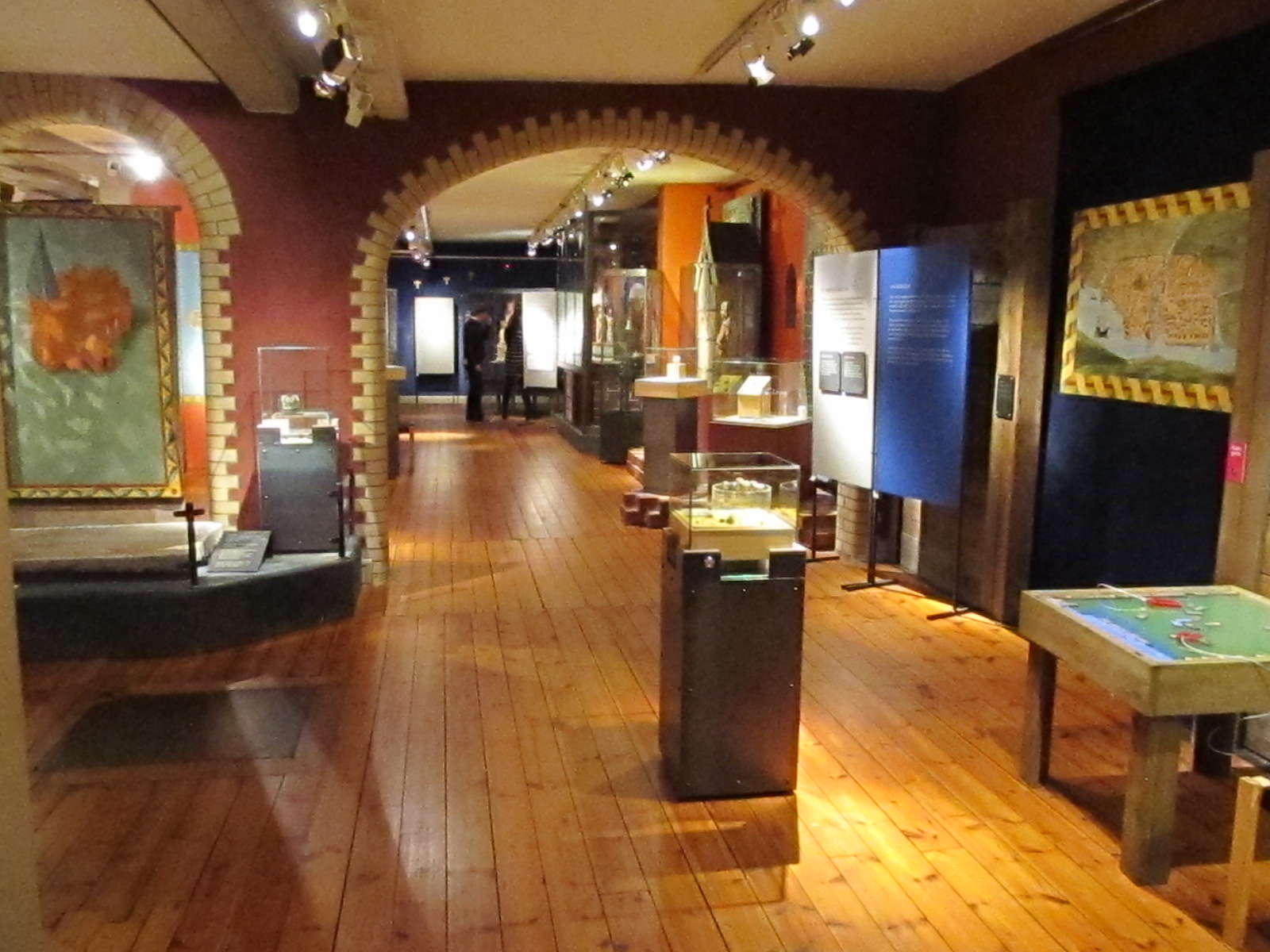
The City Museum was another gem.  Jay, a history buff on early European spice trading, was humbled to discover that the museum building was once the headquarters of the Swedish East Indian Company.  Who knew the Swedes had an Indian trading company? There were excellent exhibits on Göteborg’s history, artifacts and old photos, all in a magnificent building. Late in the afternoon we stopped at a grocery store then retired to the Royal Hotel for wine, cheese, crusty bread, salad and a movie. 

Flowers made of tiny shells
Our final day included a long walk along the 19th century constructed Göta Canal and a visit to the Maritime Museum and Aquarium. We skipped the aquarium, but were again impressed with the museum’s displays. Insights on boat building, harbor construction and hundreds of models from 400 year old sailing vessels to modern seagoing luxury and cargo ships filled the exhibit space. Boats in bottles and other seamen handicraft also shared space with a model of the MS Stockholm that has a place in history for colliding with and sinking the Andrea Doria in 1956. Large pictorial exhibits told the story of Swedish emigrants  awaiting passage to America. They were the travelers with true adventure stories to share.

Water bus in foreground
We ended the day with a short ride on one of the “water buses” that ply the canal with predictable regularity.  Back on the train by 3:45, we felt our own weekend adventure had been filled with home runs.


Sunday, April 1, 2012

Spring Fallen Back


Neighbor's tree on Spring Ridge Drive
Following our quick trip back to Atlanta in early March we reset our internal seasonal clocks to “springtime mode.”  With forsythias, azaleas and pear trees in full, colorful bloom, we dutifully reset our clocks on 11-Mar to spring forward one hour to Day Light Savings Time.  These are well-worn seasonal rhythms.

Back home in Stockholm by mid-March, we were greeted with temperatures of 120 C (low 50’s Fahrenheit), which continued our acceptance of springtime mode.   We even pulled out our bicycles and took a quick spin around the neighborhood. 

Not everything, however, went according to plan.  We awoke on Monday morning 26-Mar to a sun-filled sky and simply took this morning light to be part of the Swedish journey to endless daylight that will soon be with us. Oops…Sweden springs forward another hour on 25-Mar. Helen missed half of her gym class.  Jay showed up late at the office. Our Stockholm clocks are now synchronized with Swedish rhythms.  Another springtime custom to incorporate into our Nordic adventure.

0 degrees Celsius
So you can imagine our confusion when it snowed yesterday.

Temperatures are again hugging 00 C.   Our scarves and gloves are back in service.  The bicycles sit idle.  We are sure that this too shall pass and suspect we are becoming more Swedish than Southern with our anxious wait for blooms and blossoms.

House in Tanto Norra with "ingrown" tree
We have also discovered a section on our island home of Södermalm where Swedes fully engage in springtime with small gardens of vegetables and flowers. Tucked up against the rocky island outcroppings are the small cottages (10 sq meters – about 107 sq ft) of Tanto Norra with large garden plots of rich soil just waiting for seed, water and sunshine.

Edged bed plots
This tradition of garden plots extends deep into Stockholm history. Although neutral, World War I brought food shortages to Stockholm. City officials authorized the use of front yards and allocated garden plots in Tanto Norra for the growing of potatoes. This increased the food supply and also gave rise to a “potato war” with neighborly raids and counter-raids. Egad!

All yards and houses are fenced
Life may be more settled now, but in land-scarce Stockholm the demand for a plot allotment traces an arc of desire similar to the hunger for European potatoes seen in the opening of the last century.  Over 200 people pay a yearly fee of SEK 100 ($15) to be on the “interest list” for an allotment.  Swedes are patient and orderly.

Tiny Houses at Tanto Norra
For the wait, as the literature says, one can enjoy the pleasure of a small piece for earth beneath one’s feet and the experience of a “warm summer evening with tack herring in a divine sour cream sauce with chopped chives and the aroma of dill boiled potatoes mixed with meatballs filling the honeysuckle scented air.  One can only sigh that a summer in Tanto beats everything.” Another custom learned in our Nordic wanderings.

Monday, March 19, 2012

Norwegian Days


Since November, Jay has been traveling to Oslo on a sales pursuit.  With the sales cycle coming to a close at the end of March, Helen took advantage of Jay’s recent trip and joined him for a few days of Norwegian sightseeing.  With winter fading we were happy to be greeted by sunny skies in this modern, well-heeled Norwegian capital with a history that stretches back over 1,000 years. 
From 800 – 1000 AD, Norwegian history is interwoven with the Viking age.  Like Swedes and Danes of that time, Norwegian Vikings sailed longboats to neighboring lands to trade, plunder and settle.  More westward looking than their neighbors, Norwegian Viking settlements have been found in Britain, Ireland, Iceland and Greenland.  Viking pride points to the “discovery” of North America centuries before Columbus’s encounter with the New World.  We often wonder how the North American Indians felt about being “discovered” . . . but that is another story in itself.

Over the centuries, Norway was in political union first with Denmark (1523 – 1814) and then Sweden (1814-1905). Independent and impoverished at the dawn of the twentieth century, Norwegians invested in education and use of its natural resources in timber, hydro-electric and more recently oil.  Norway now has an enviable standard of living for its 4.8 million inhabitants.

We started with a walking tour of the imposing Akershus Fortress.  Construction on the fortress started in 1290 and continued for centuries, providing protection for the harbor.  The fort has never surrendered under siege.  It was only in 1940 when the Nazis entered neutral Norway and the Norwegian government evacuated the capital that the fort was occupied.  A memorial stands today for those who did resist.
Oslo Fjord Coast Line

Next was a two-hour fjord boat ride.  Like Swedes, Norwegians are keen to have a summer cottage in the archipelago.  Many summer homes found on the islands adhere to a building code requiring homes to be no larger than 30 square meters and be painted white, red or orange.  Traditional small bathhouses dotting the rugged, rocky fjord coastlines add to the quaint and postcard picturesque imagery.

The Kon-Tiki 
Best preserved ship at Viking Museum 
On Monday Jay headed to the office and Helen bought a 24-hour Oslo Pass giving her pre-paid admission to museums and travel on public transport. The first stop was Museum Road.  The Kon-Tiki Museum was the most interesting, displaying boats and artifacts from Thor Heyerdahl’s famous expeditions.  Also visited was the Fram Museum displaying a ship that traveled to both North and South Poles and the Viking Museum with excavated ships that had been used as tombs.

A reception room in Oslo City Hall
The Nobel Peace Center was closed, but right across the street was City Hall, open to the public. This is where the Nobel Prizes are actually awarded. The 28 ft. high walls in several rooms were surprisingly decorated with huge murals depicting various Norwegian scenes.

We completed our touring with a marvelous dinner at a 300-year old restaurant.  Another memory added to our European adventure.


Saturday, March 10, 2012

Goin' to the Chapel of Love

Joy and Eric show their wedding rings

Great happiness and expectation filled us as we traveled back from Stockholm to our home in Roswell, Georgia for the wedding our son Eric to the most wonderful Joy Beckner.  A full phalanx of family and friends assembled at the Duluth Festival Center to bear witness to the union of the Borland and Beckner clans. 
Joy and Devin Borland

Proud parents beamed unabashedly, but the real sparkle of the day was from six-year old Devin who basked in a future life with Mom and Dad forever by his side.  We have much to be thankful for.

American weddings are crafted around the recognized traditions of expressed vows, exchanging of rings, the first dance and cutting of cake, so that there is little need for explanation. 
Cards Table Decorations 
 Wedding theme, "Two of a Kind."
We will instead share pictures and images from the rehearsal and service and wish for Eric and Joy the same expectation shared at our wedding, “May this be the day that Joy and Eric love one another the least.”
Rehearsal Dinner Guests

Chupa at Wedding Site


Sunday, March 4, 2012

Semlor and Pretty in Pink


Swedish Semlors

Semlor is another long-held Swedish tradition that entered our lives with mystery and confusion.  A light wheat bread bun filled with almond paste and cream marks Fettisdagen.  This moveable holiday associated with the Lenten season first came to our attention when Jay’s office manager sent out a broadcast e-mail on 21 February stating, “Today is Fettisdagen so please grab a semlor in the kitchen.”

Alerted to this holiday, we began noticing bakery signage imploring all to partake in this traditional treat.  We also noticed their shelving was filled with offerings of this cream-filled delight. 

Sign says, "I will follow you home!"
Then, two days later, news stories appeared announcing the birth of Princess Estelle Silva Ewa Mary.  This new princess was born to the daughter of the current king and queen of Sweden.  Following the birth announcement, semlor found itself sharing bakery shelving with pink cakes topped with “Estelle” scribed in icing.

Royalty is not part of our American DNA so, as with semlor, we were required to do some research to improve our understanding.

Aside from bakery goods and the occasional child holding a pink balloon, we did not see a great deal of street-chatter on the birth of this new royal. Unlike the British royalty, Swedish royals appear to occupy a warm but limited place in Swedish life.  Bear in mind, we have no clue of the proper way to serve semlor, so our observation on Swedish relationship to its royalty could be wildly inaccurate. 

We are, however, slowly stitching together our appreciation of Swedish tradition and history.   When we first arrived in Stockholm, Gustav Adolf Square and its bronze statue of the horse mounted by King Gustav II Adolf was just a place to buy tickets for a canal cruise tour.

We have since learned that square, rather than the central train station, is considered the geographical center of Stockholm from which distances to other localities are measured.   King Gustav II Adolf who is honored by the statue and square was king of Sweden from 1611 to 1632. He sparred heavily with the Danes, Russians, Poles and others to lay claim of dominance in the Baltic Sea.  In this martial pursuit, this king ordered the building of the mighty warship, Vasa.

The Vasa
That warship moved into Swedish lore by its Titanic-like sinking on it maiden voyage in 1628.  In the 1960’s, the Vasa was raised from Stockholm harbor and is now a national treasure and marquee tourist attraction.

We have, for the moment, pressed the “pause” button on our Swedish adventure as we prepare for a short trip back home to Atlanta for the marriage of our son Eric.  We are also looking forward to the easy movement through an American environment with which we are familiar.  One can consume just so much mystery and confusion before taking a break.